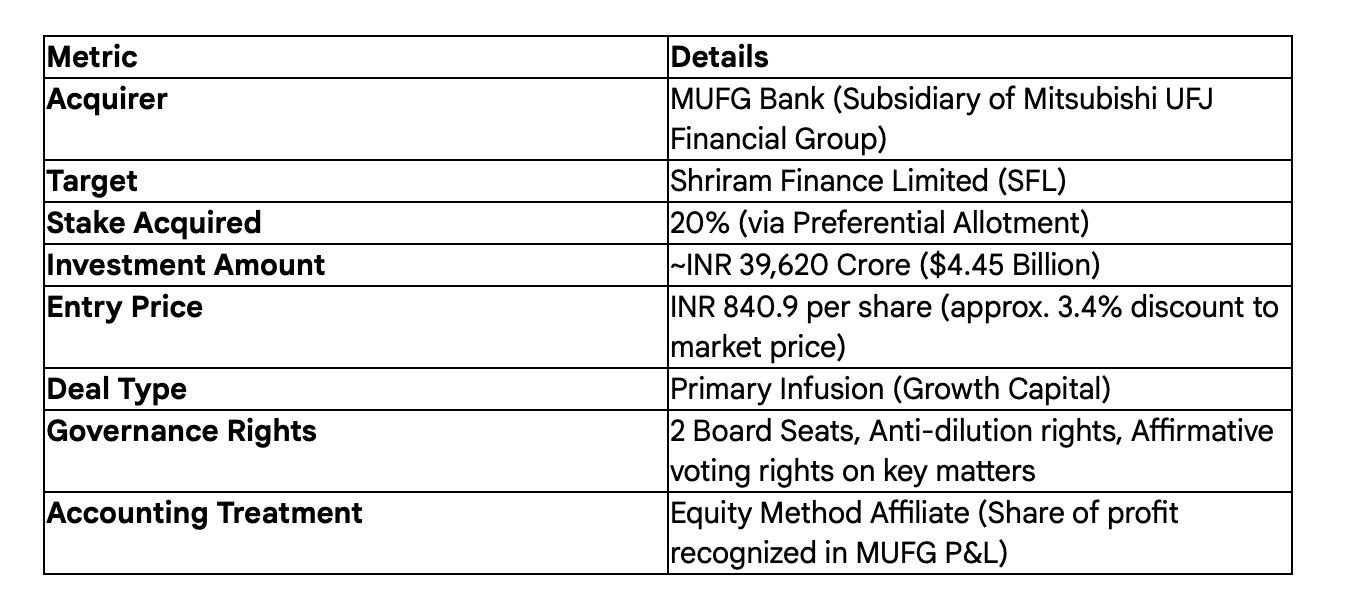
A Deep Dive into the MUFG-Shriram Deal-


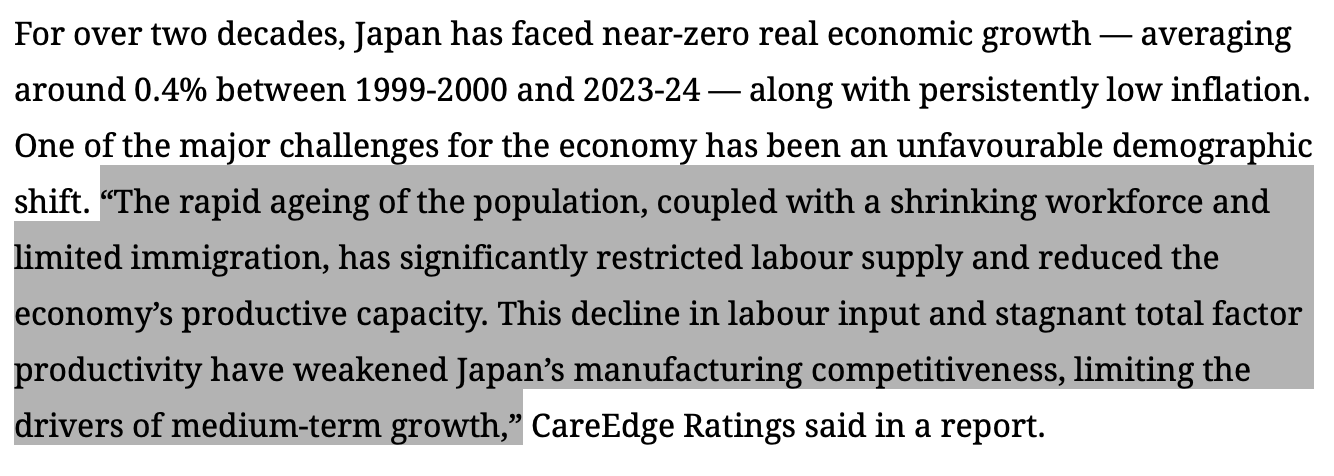
So, MUFG can’t grow its loan book more than the Japanese GDP. MUFG was forced to move beyond its nation and look out for economies having good credit demand and demographic stability. India has a rising workforce population with robust credit demand in all sectors, including business loans (MSMEs), personal loans, home loans, and corporate loans. Therefore, by buying a 20 percent stake in an Indian NBFC, they are not only buying a piece of their balance sheet but also the long growth ahead with a rising population and credit demand.
So, the yield arbitrage will be the soul of the deal. The borrowing cost of Yen is very low and the application of this fund is at a very high-yield asset. Even after accounting for hedging costs, the profit expectation is very powerful, which will in return boost the Return on Equity (ROE) for MUFG.
For decades, Japanese banks had substantial exposure in China. But as the geopolitical concerns between Japan and China are rising, banks were forced to look for better alternatives. Also, China is facing a decline in domestic consumption which would directly impact the credit demand in the country. It is acting as a good “China+1” for India. MUFG’s strategy is to have a long-term partnership with India because it is offering safe capital deployment compared to other emerging markets due to improving regulatory clarity.
As India’s Credit-to-GDP ratio is around 60 percent, which is below the 100 percent of other advanced economies, it offers headroom for expansion in credit growth. As we all know, the major indicators such as population growth and a rate-cut environment are all in favor of credit expansion, which will give MUFG’s India investment an edge over other emerging markets.
By investing in India’s largest NBFCs, they get direct and deep-rooted access to the retail and vehicle lenders of the country. We will dig deeper into why MUFG chose Shriram Finance.
A decade ago, the Indian banking industry was going through a tough phase of defaults in corporate loans, bad loans, and huge collapses around IL&FS and DHFL. This forced the RBI to come up with regulatory reforms and tighter supervision and eventually cleaned up the balance sheet of banks, which resulted in gaining confidence in the banking sector again. Now, the banking sector is much more transparent and leaner, which boosted the confidence of FDI to invest heavily in India.
Also, India is a very unpenetrated market in the case of credit growth because most of the borrowing is still done through uncredited sources. This is where FDI saw a huge opportunity as India is an economy which has rising consumption, rapid urbanization, and a drive towards premiumization which would boost credit growth for both banks and NBFCs. We’re seeing demand in retail, housing, and corporate loans. India is also growing at a rate of 8.2 percent which will further increase optimism around FDI investment. Despite concerns over FDI outflows and a weakening rupee, the Indian banking sector is seeing a turnaround with 15 billion dollars of capital inflows this year as compiled by Bloomberg. One more crucial factor which I see is the mass penetration of UPI (Unified Payment Interface) which makes it very easy for people to borrow, lend, and transact. This also shows the strong digital ecosystem that India possesses. So, by buying stakes in Indian banks they are directly buying time and scale at once which are massively penetrated in India. Also, for generating alpha, India is acting as a safe haven during global turmoil that is taking place affecting global financial and supply chain crises.
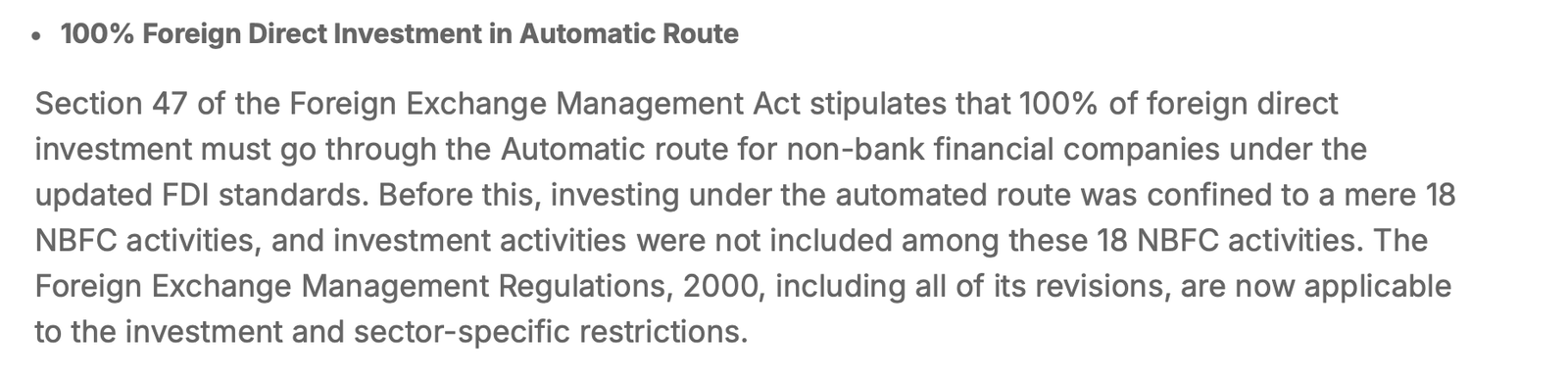
The government is also figuring out regulatory reforms through which they can push FDI investments more without compromising the essential characteristics of a bank and the decision-making ability of their boards.
1. Bajaj Finance
2. Cholamandalam
3. Muthoot
4. Shriram Finance
So, if we look at or just screen it, Bajaj Finance must be looking expensive at a P/B of 5x, which is far more than that of other competitors. Then Cholamandalam must have been a good option, but valuation-wise Shriram was at a much sweeter spot. Whereas Muthoot had a concentration risk of gold loans. So, just by looking, we can say that Shriram Finance (P/B ratio – 2.8x) with valuation comfort was the best option. With an AUM exceeding INR 2.8 trillion, it offers the scale that can absorb MUFG’s large ticket size.